Hey, I’m Barry Zeng. I’ve been in manufacturing for 12 years at YOVUTEK, and I’ve watched the conversation around 3D printing shift dramatically. Ten years ago, it was purely a prototyping tool. Five years ago, it became a niche process for expensive parts. Today, however, 3D printing makes production more cost-efficient in ways that most engineers still don’t fully realize. I’m not talking about marketing hype here—I’m talking about real numbers, real production runs, and real savings. For example, a single design change recently cut a client’s assembly cost by 60%. Furthermore, a printed mold insert replaced a $15,000 steel tool. Meanwhile, parts that used to take three weeks to source now arrive in three days. In this article, I want to walk you through how 3D printing makes production cheaper in practice. Grab a coffee, and let’s get into it.
How 3D Printing Makes Production More Cost Efficient?
Let me start with the story that made me a true believer. About five years ago, a robotics startup came to us with a design for a structural bracket assembly. It originally consisted of seven separate machined aluminum parts bolted together, costing $340 per assembly with a three-week lead time.
When we reviewed the design, we noticed something they hadn’t considered. Those seven parts were merely doing what one unified component could do. Therefore, we redesigned the assembly into a single 3D printed part using carbon fiber reinforced nylon. As a result, the new component maintained the exact same strength with zero assembly labor.
Consequently, the new cost dropped to $135 per assembly, while lead time fell from three weeks to just five days. That represents a 60% cost reduction and a 75% lead time savings—all from one process change.
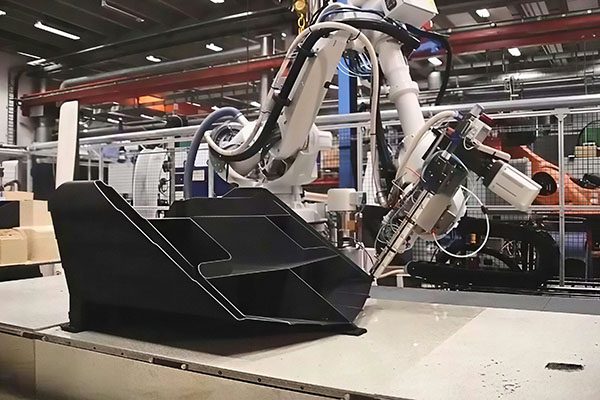
This illustrates the primary way 3D printing makes production more cost-efficient: it consolidates complex assemblies. When you print an assembly as a single piece, you eliminate fasteners, manual labor, and assembly errors simultaneously. For multi-part projects, this savings often outweighs everything else.
The Tooling Problem — And How 3D Printing Eliminates It
Let’s examine the biggest cost driver in traditional manufacturing: tooling. For instance, injection molding a plastic part requires a steel mold costing anywhere from $10,000 to $100,000. Similarly, die casting metal parts calls for dies that cost even more, while stamped sheet metal requires custom dies.
Obviously, tooling costs must be paid upfront before any part is made. If you produce a million units, the tooling expense per part becomes negligible. However, if you only need a few hundred parts, tooling becomes the dominant expense.
In contrast, 3D printing makes production far more cost-efficient by removing tooling entirely. Because there are no molds or stamping dies, you transition directly from a CAD file to a finished part. As a result, the first unit costs the exact same as the hundredth unit, with zero upfront investment required.
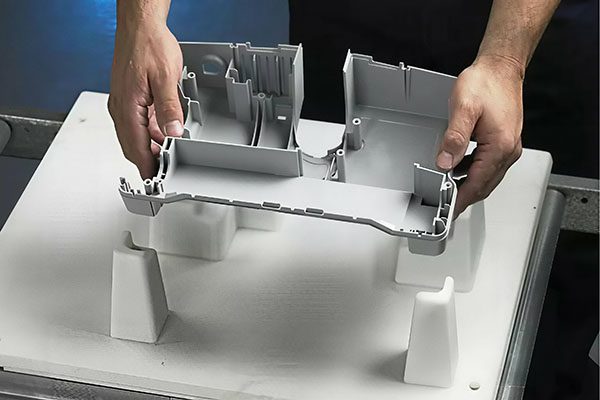
Indeed, I have seen this save clients tens of thousands of dollars. For example, a customer needed 200 custom enclosures. Traditional injection molding would have required a $25,000 mold. Instead, we printed them in SLS nylon for $40 each ($8,000 total). Thus, they saved $17,000 and received their parts in one week instead of six.
Ultimately, this tooling advantage makes additive manufacturing the ideal solution for low-to-medium volume production runs.
👇 Can 3D Printing Make Your Production More Cost-Efficient? Let’s Find Out.
Send me your CAD file or drawing. I’ll quote it both ways — traditional manufacturing and 3D printing — and tell you which one is cheaper for your quantity. Free DFM report and quote within 24 hours. No robots, no voicemail. Just me and my honest opinions.
📞
Call Barry
I answer the phone myself
(No “press 1,” I promise)
Contact our team
📧
Email Your Specs
Free DFM & production quote
(I reply within 24h, even on weekends)
🌐
Visit Our Site
Learn more about our production capabilities
(3D printing, CNC, sheet metal, and a picture of my cat)
P.S. Mention “production cost guide” when you email, and I’ll send you my personal checklist for evaluating whether 3D printing can make your production more cost-efficient.
Barry Zeng
Senior Manufacturing Engineer, YOVUTEK
(12 years of manufacturing experience. I’ve quoted thousands of parts in both 3D printing and traditional processes. I can help you find the most cost-efficient answer.)